Hard Rock and Seminole Expand Player Protection in 2026
Responsible gambling is becoming increasingly visible across the American casino industry, and September 2026 is providing perhaps the clearest demonstration yet of how major operators are attempting to move player protection beyond small-print warnings and regulatory obligations.
MGM Resorts International and BetMGM have announced a combined $320,000 commitment to responsible gaming initiatives as part of Responsible Gaming Education Month 2026, while Hard Rock International and Seminole Gaming are simultaneously expanding their own PlayersEdge programme through new education campaigns, research partnerships, digital tools and employee training.
Taken together, the announcements reveal a significant development in the relationship between American casinos and responsible gambling.
Player protection is increasingly moving out of the compliance department and into the customer experience itself.
Responsible gaming messages are appearing on Las Vegas marquees, inside sportsbooks, across professional sports stadiums, on digital gaming platforms, within live casino studios and through direct customer communications.
For a destination such as Las Vegas, where casino gaming sits alongside sport, entertainment, hospitality and increasingly sophisticated digital gambling products, that evolution is particularly important.
At E-Vegas.com, we have long argued that gambling should remain entertainment rather than being treated as a way to make money. Our own Responsible Gambling guide and Safer Gaming resources form an important part of that approach.
What is notable about the September 2026 announcements is that some of the largest names in American gaming are increasingly bringing that philosophy directly into the environments where people gamble.
MGM Resorts and BetMGM Commit $320,000 to Responsible Gaming
MGM Resorts and BetMGM are once again working with the American Gaming Association during Responsible Gaming Education Month.
The companies say they are directing a combined $320,000 toward responsible gaming initiatives, including research, problem-gambling services and organisations developing new approaches to player support.
Part of that funding will support research through the International Center for Responsible Gaming, one of the best-established organisations researching gambling behaviour, addiction and player protection.
Additional funding is being directed toward state problem-gambling councils and support services associated with the US 1-800-GAMBLER helpline.
The companies are also supporting the Evive Foundation, which works to provide digital tools and peer support to people affected by gambling-related problems.
The significance of the announcement is not simply the monetary contribution.
It demonstrates how responsible gaming is increasingly being incorporated into the wider operating infrastructure surrounding casinos, sportsbooks and online gaming businesses.
GameSense Expands Across Las Vegas and American Sport
One of the most visible parts of MGM’s responsible gaming strategy remains GameSense.
The programme was originally developed by the British Columbia Lottery Corporation and licensed to MGM Resorts in 2017.
Rather than approaching responsible gambling purely through warnings about problem gambling, GameSense is intended to encourage informed decision-making before problems develop.
That distinction is important.
Modern safer gambling strategies increasingly focus on helping players understand concepts such as probability, budgets, time spent gambling and the randomness of game outcomes rather than only intervening once significant harm has already occurred.
During September 2026, GameSense messaging is appearing across a remarkably broad range of environments.
In Las Vegas, that includes T-Mobile Arena, home of the Vegas Golden Knights, and Michelob ULTRA Arena, home of the Las Vegas Aces.
It also includes Allegiant Stadium, home of the Las Vegas Raiders.
The programme reaches considerably further than Nevada.
GameSense messaging is also appearing through stadium and ballpark placements connected with NFL and MLB teams including the Pittsburgh Steelers, Denver Broncos, Detroit Lions, Kansas City Chiefs, Philadelphia Eagles, Baltimore Ravens, New York Jets, Tennessee Titans, Arizona Cardinals, Cincinnati Reds, Detroit Tigers, Boston Red Sox, Pittsburgh Pirates and Washington Nationals.
That distribution is strategically interesting.
The rapid expansion of legal sports betting across the United States means professional sport has become one of the most important environments in which gambling brands interact with consumers.
Responsible gaming messaging is consequently beginning to occupy the same environments.
Instead of responsible gambling being hidden several clicks deep inside a sportsbook website, it can appear directly on LED ribbons and scoreboards in front of tens of thousands of spectators.
Las Vegas Marquees Become Responsible Gaming Media
The campaign becomes even more interesting in Las Vegas itself.
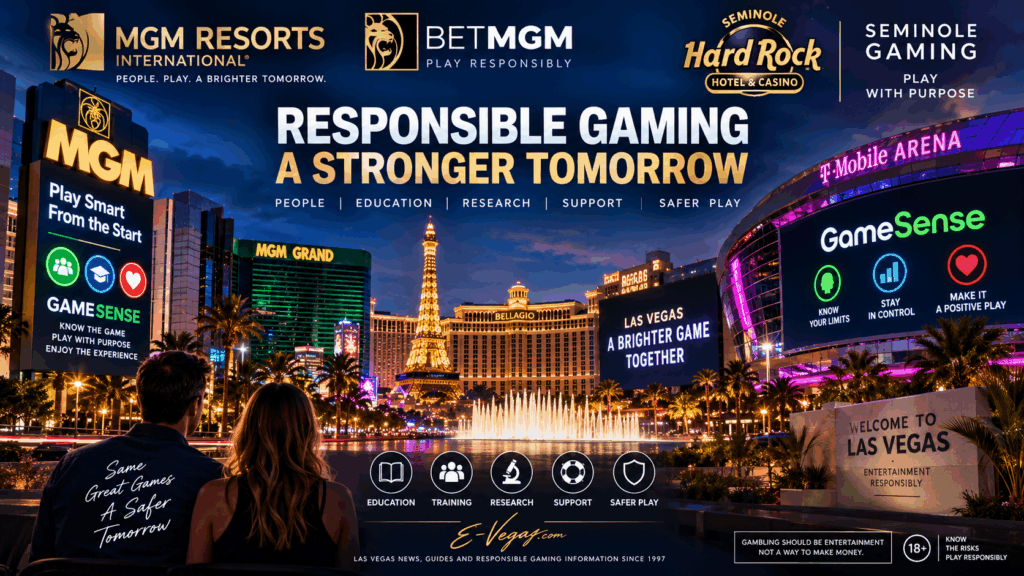
MGM Resorts’ famous Las Vegas marquees are being used during September to display GameSense material alongside the American Gaming Association’s Play Smart from the Start campaign.
For decades, Las Vegas marquees have been among the most valuable advertising surfaces in gaming and entertainment.
They promote residencies.
Restaurants.
Casino promotions.
Sporting events.
Nightlife.
Shows.
Jackpots.
Hotel offers.
Using those same screens for responsible gambling messaging gives player protection a degree of visibility that traditional regulatory notices rarely achieve.
It places responsible gaming inside the visual language of Las Vegas rather than outside it.
That is potentially a much more powerful approach.
Responsible Gaming Reaches MGM Grand Live Dealer Gaming
Another particularly important element of the programme is its connection with the MGM Grand Live Dealer studio.
Live casino technology has created one of the strongest connections yet between physical Las Vegas casinos and digital gambling.
Real casino tables can be streamed to appropriately licensed online operators, allowing players outside Nevada to participate remotely where local regulation permits it.
E-Vegas.com has been following this development closely because it represents a fundamental shift in what online casino gaming can mean.
Our coverage of Live From Las Vegas casino gaming shows how UK-facing operators can provide live dealer games associated with major Las Vegas properties such as MGM Grand and Bellagio.
The involvement of the MGM Grand Live Dealer studio in Responsible Gaming Education Month therefore matters.
It demonstrates that responsible-gambling principles need to travel with the game.
When the Las Vegas casino floor effectively becomes a broadcasting environment serving remote customers, the responsibility associated with that experience also extends beyond the physical casino.
That relationship between Las Vegas live gaming, digital distribution and responsible gambling is likely to become increasingly important as live casino technology develops.
More Than 3,000 GameSense Advisors
MGM Resorts and BetMGM have also reached another significant milestone.
More than 3,000 employees have now been certified through the GameSense Advisor programme.
Employees from more than 45 departments have participated.
That is important because responsible gaming does not only concern dealers, sportsbook staff or casino management.
Large integrated resorts such as MGM Grand, Bellagio, ARIA and Mandalay Bay contain enormous numbers of employees working across hospitality, restaurants, entertainment, retail, security, customer service and gaming.
A visitor’s interaction with a casino resort therefore extends far beyond the gaming floor.
Training employees across multiple departments helps embed responsible gambling into the broader resort culture rather than treating it as an isolated casino-floor responsibility.
BetMGM Encourages Players to Take a Time-Out
Digital gambling creates different challenges.
A physical casino requires someone to be physically present.
A sportsbook application can potentially be accessed from a smartphone within seconds.
That accessibility makes effective player-control tools particularly important.
During Responsible Gaming Education Month, BetMGM is using sportsbook messaging encouraging customers to take a time-out, with QR codes directing customers toward responsible gaming information and tools.
Customers are also expected to receive targeted responsible-gaming emails promoting GameSense resources.
The concept of taking a break is straightforward, but the technological implementation matters.
Digital gambling platforms can potentially provide tools that physical casinos cannot.
Players can set limits.
Accounts can be temporarily suspended.
Activity can be recorded.
Customers can receive alerts.
Deposits can be restricted.
Self-exclusion can be implemented across defined systems.
That means digital gambling creates additional risks through increased accessibility, but it can also provide sophisticated mechanisms for managing gambling behaviour.
MGM Resorts Works With Researchers and Support Organisations
MGM’s September programme also extends into academic research.
The company is working with Carleton University on research examining casino employees and responsible gaming.
MGM Resorts also plans to work with the Nevada Council on Problem Gambling to operate educational booths at Las Vegas properties during September.
Meanwhile, BetMGM continues working with EPIC Global Solutions, an organisation known for incorporating the lived experiences of people affected by gambling harm into education and training.
Employees are being given opportunities to attend sessions explaining the human impact that problem gambling can have.
That lived-experience element is significant.
Compliance training can explain regulations.
Statistics can explain the scale of gambling-related harm.
But hearing directly from people whose lives have been affected by gambling can help employees understand why responsible gambling controls exist in the first place.
Hard Rock and Seminole Gaming Expand PlayersEdge
MGM and BetMGM are not alone.
Hard Rock International and Seminole Gaming are using Responsible Gambling Education Month to expand their own PlayersEdge programme.
Responsible gambling education has formed part of Hard Rock Casino and Seminole Gaming employee training since 2021.
PlayersEdge combines several areas of responsible gambling activity.
These include player education, staff training, research and intervention resources.
The programme is intended to work across different categories of player rather than assuming that everyone interacting with a casino has the same level of gambling knowledge or risk.
That approach reflects an increasingly sophisticated understanding of responsible gambling.
Someone visiting a casino for the first time may need very different information from an experienced customer.
A casual player might benefit from simple explanations about probability and bankroll management.
Someone beginning to experience difficulty controlling their gambling may require considerably stronger interventions and support.
Hard Rock’s New ‘Chance’ Campaign
One of Hard Rock’s most interesting new initiatives is its Chance campaign.
The message behind it is remarkably simple:
gambling outcomes cannot reliably be predicted or controlled.
That may sound obvious, but misunderstanding randomness is one of the most persistent behavioural issues associated with gambling.
Players can fall into the trap of believing a roulette wheel is somehow “due” to land on a particular colour.
A slot player may believe a machine that has not paid recently must be approaching a win.
Someone may interpret several losses as evidence that their luck is about to change.
Others may believe particular rituals or betting patterns influence statistically random events.
They do not.
Hard Rock’s Chance campaign attempts to address those misconceptions directly.
The principle is essentially that while a player cannot control chance, they can control their behaviour.
They can decide how much money to spend.
They can decide how long to play.
They can choose when to stop.
They can decide not to chase losses.
They can choose whether to gamble at all.
That distinction sits at the heart of responsible gambling.
Gambling Is Entertainment, Not Income
The same principle underpins E-Vegas.com’s own Responsible Gambling policy.
Casino games involve financial risk.
There is no betting system capable of turning a negative-expectation casino game into a guaranteed source of income.
Winning sessions happen.
Jackpots happen.
Players can leave a casino ahead.
But gambling should not be approached as a financial plan.
That is particularly important in an era when casino content is increasingly presented through highly polished digital entertainment.
Live dealer studios resemble television productions.
Game shows use presenters, music and elaborate sets.
Slot games incorporate cinematic graphics.
Sports betting is integrated into mobile applications.
Casino creators publish jackpot videos through YouTube and social media.
The entertainment can become extremely engaging.
The financial risk remains real.
Responsible gambling requires keeping both facts in view.
Hard Rock Experiments With Digital Health Technology
Hard Rock is also experimenting with technology as part of its responsible gaming approach.
The company has piloted the Almond Digital Health App at Hard Rock Casino Cincinnati.
The multilingual platform is designed to allow users to access responsible-gambling and behavioural-health resources anonymously.
Hard Rock says it is evaluating whether the programme should continue in Cincinnati and potentially be expanded to additional properties.
This points toward another important development.
Responsible gaming technology may increasingly move beyond controls located inside casino accounts.
Support services could become digital products themselves.
Apps can potentially provide education.
Personalised resources.
Behavioural information.
Peer support.
Connections with treatment services.
Self-assessment tools.
The same smartphone that makes gambling highly accessible can therefore also become a platform through which safer-gambling support is delivered.
Hard Rock Joins the Better Gambling Forum
Hard Rock and Seminole Gaming have also become founding members of the Better Gambling Forum.
The initiative brings together organisations interested in evidence-based approaches to gambling, brain health and behavioural resilience.
For the casino industry, collaborations of this kind are important because responsible gambling remains an evolving discipline.
Operators can implement controls and training programmes, but understanding which interventions genuinely change behaviour requires research.
Measures should ultimately be judged by evidence.
Do players understand the information?
Do limits reduce harm?
Does employee training improve interventions?
Do messages displayed in casinos influence behaviour?
Which tools do players actually use?
At what point should operators intervene?
Those are research questions as much as commercial or regulatory questions.
Five Hard Rock and Seminole Casinos Enter Research Programme
Five Hard Rock and Seminole Gaming casinos are participating in research led by Michael Wohl and his team at Carleton University.
The project is examining organisational factors that may support or obstruct effective responsible gambling initiatives.
The research is independently funded through the International Center for Responsible Gaming.
This is a particularly interesting area of study because having a responsible gambling policy and successfully implementing one are not necessarily the same thing.
Employees must understand the policy.
Managers need to support it.
Customers need to recognise the tools.
Staff need confidence when approaching difficult situations.
Commercial pressures cannot be allowed to undermine intervention.
Responsible gambling consequently becomes a question of organisational culture rather than simply policy wording.
Responsible Gaming Is Becoming Part of Casino Competition
There is another commercial dimension to all of this.
Casino companies traditionally competed through games, hotel rooms, loyalty programmes, promotions, entertainment, restaurants and service.
Responsible gaming may increasingly become another point of differentiation.
Consumers are becoming more conscious of licensing, security, data protection and responsible gambling tools.
Regulators increasingly expect sophisticated player-protection systems.
Investors are paying greater attention to ESG and governance issues.
Major commercial partners may be reluctant to associate themselves with operators perceived as irresponsible.
Sports leagues and media companies also face reputational risks when working with gambling businesses.
As a result, effective responsible gambling programmes are no longer solely a cost of regulation.
They are increasingly part of brand reputation.
Las Vegas Is Particularly Important
This matters enormously in Las Vegas.
The city has evolved far beyond the traditional image of casino gambling.
Modern Las Vegas combines gaming with major league sport, global entertainment, restaurants, nightlife, conventions, hospitality and enormous resort complexes.
Professional sports have become particularly prominent.
The Las Vegas Raiders play at Allegiant Stadium.
The Vegas Golden Knights play at T-Mobile Arena.
The Las Vegas Aces play at Michelob ULTRA Arena.
Formula 1 races through the city.
The Athletics are developing their future Las Vegas ballpark project.
Gaming brands are therefore interacting with audiences far beyond traditional casino floors.
Embedding responsible gaming information across those environments acknowledges that gambling is now connected to the wider entertainment economy.
Live Gaming Makes Responsible Gambling Even More Relevant
The expansion of live casino deserves particular attention from an E-Vegas perspective.
The old distinction between physical casino gambling and online gambling is becoming less clear.
A player may sit at home in Britain while watching cards dealt from a genuine table connected with Las Vegas.
This produces an extraordinary entertainment experience.
It also means that the standards expected from digital gambling environments must accompany the experience.
UK players should always use appropriately licensed operators.
They should understand game rules.
They should check betting limits.
They should avoid chasing losses.
They should decide what they can afford to spend before playing.
They should use deposit, loss and time controls where available.
They should stop whenever gambling stops being enjoyable.
Those principles apply whether someone is sitting inside MGM Grand itself or accessing authorised live casino content thousands of miles away.
Readers interested in how these experiences work can explore E-Vegas.com’s coverage of Live From Las Vegas casino gaming alongside our independent Safer Gaming information.
Gambling Regulation Is Also Becoming More International
Responsible gambling strategies differ between jurisdictions.
Britain has one of the world’s longest-established regulated remote gambling markets, overseen by the UK Gambling Commission.
The United States operates through a state-by-state regulatory structure.
Canada has its own provincial systems.
That makes international casino brands increasingly responsible for adapting player protection to different markets.
A global gambling company cannot necessarily adopt one policy and assume that it applies everywhere.
Regulatory expectations differ.
Self-exclusion systems differ.
Advertising requirements differ.
Deposit controls differ.
Online gambling availability differs.
Sports betting rules differ.
But the underlying principle should remain relatively consistent:
the customer should be able to enjoy gambling without being encouraged to lose control.
Responsible Gaming Should Not Be Limited to September
Responsible Gaming Education Month provides useful visibility, but the greatest test is what happens during the remaining eleven months of the year.
Player protection cannot be a September marketing campaign.
It needs to exist every day.
Casino employees need training throughout the year.
Digital controls need to remain available.
Support organisations require sustained funding.
Player behaviour needs continuous monitoring where regulation requires it.
Research needs to continue.
Responsible gambling information needs to remain accessible even when there is no national awareness campaign taking place.
That is why the structural elements of these announcements matter more than the slogans.
MGM and BetMGM are funding research.
Employees are receiving training.
GameSense is being integrated into sports venues.
Hard Rock is experimenting with digital health technology.
Casinos are participating in academic studies.
Responsible gambling programmes are being incorporated into operational culture.
Those initiatives have the potential to continue long after Responsible Gaming Education Month ends.
A More Mature Gambling Industry
The developments also illustrate a broader maturation of the gambling industry.
Casinos will always exist to provide gambling.
Sportsbooks will always want customers to bet.
Online casino operators are commercial businesses.
Responsible gambling does not change those realities.
What it can change is how the relationship between operator and customer is managed.
A sustainable gambling industry cannot ultimately depend on customers losing control.
The strongest long-term model is one in which people who choose to gamble understand what they are doing, recognise that losses are possible, set boundaries and retain control over their behaviour.
That principle is increasingly visible in the programmes announced by MGM Resorts, BetMGM, Hard Rock International and Seminole Gaming.
From Compliance Requirement to Entertainment Standard
Perhaps the most significant development is the gradual transformation of responsible gambling from a compliance requirement into an expected component of the entertainment experience.
A modern casino operator is increasingly expected to provide more than games.
Customers expect security.
Fairness.
Regulation.
Transparent rules.
Reliable payments.
Data protection.
Customer support.
Responsible gambling tools.
Clear information.
That applies online and offline.
As live casino, mobile betting, professional sport and Las Vegas entertainment increasingly intersect, responsible gaming will need to be integrated into all of them.
MGM’s use of GameSense inside sports venues is one example.
BetMGM’s digital time-out messaging is another.
Hard Rock’s Chance campaign is another.
Digital health applications are another.
Employee training provides another layer.
Research provides the evidence required to determine which approaches actually work.
Las Vegas Can Lead by Example
Las Vegas is frequently viewed as the global capital of gambling.
That means the city has an opportunity to become equally prominent in demonstrating how modern gambling can be delivered responsibly.
Seeing responsible gambling messages on MGM marquees, inside T-Mobile Arena, within sportsbooks and through live dealer environments sends an important signal.
Player protection does not have to exist somewhere outside the entertainment.
It can be built into it.
The casino can remain exciting.
The sportsbook can remain entertaining.
Live roulette can remain dramatic.
The Las Vegas Strip can remain spectacular.
None of that requires pretending gambling is risk-free.
In fact, treating customers as informed adults arguably requires the opposite.
It means explaining that games involve chance.
It means explaining that losses are possible.
It means providing tools for setting boundaries.
It means making help accessible.
It means training staff to recognise problems.
And it means accepting that sometimes the responsible outcome is for someone not to gamble at all.
The E-Vegas View
At E-Vegas.com, our interest in Las Vegas gaming has always extended beyond simply showing readers where games can be played.
The long-term credibility of both physical and online casino entertainment depends on regulated, transparent and responsible operation.
That becomes even more important as the boundaries between Vegas and online gaming continue to disappear.
British players can increasingly access sophisticated live dealer experiences connected with Las Vegas.
Casino brands increasingly operate across physical resorts and digital platforms.
Sports betting is closely integrated with major league sport.
Gaming content reaches enormous audiences through social media and streaming.
The casino industry has consequently become part of a much larger entertainment ecosystem.
Responsible gambling needs to evolve with it.
The initiatives being introduced by MGM Resorts, BetMGM, Hard Rock International and Seminole Gaming during Responsible Gaming Education Month 2026 suggest that some of America’s largest gaming companies recognise that reality.
The combined $320,000 commitment from MGM Resorts and BetMGM is significant.
The expansion of GameSense is significant.
Three thousand trained GameSense Advisors is significant.
Hard Rock’s PlayersEdge programme is significant.
Research partnerships matter.
Digital support tools matter.
But perhaps the most important development is where these initiatives are appearing.
They are moving onto casino floors.
Into smartphones.
Onto stadium screens.
Across sportsbooks.
Into employee training.
Onto Las Vegas marquees.
And even into the rapidly developing world of live casino broadcasting.
Responsible gambling is therefore becoming less peripheral to the gaming experience and increasingly part of the infrastructure supporting it.
For an industry that wants to remain a sustainable part of global entertainment, that is exactly where it belongs.
E-Vegas.com — Las Vegas, online casinos and responsible gaming information since 1997.
18+. Gambling should be entertainment, not a way to make money. Set limits, never chase losses and only gamble with money you can afford to lose. Visit the E-Vegas.com Responsible Gambling Centre for information, safer gambling tools and support resources.