William Hill Vegas: When the Las Vegas Is Real Not Imitation
The word “Vegas” is one of the most valuable pieces of vocabulary in the gambling industry.
Online casinos use it constantly. Games use it. Promotions use it. Casino websites use photographs of the Strip, neon signs, roulette tables, luxury hotels and unmistakably Las Vegas imagery to create an immediate association between playing online and visiting the gambling capital of the world.
There is an obvious reason for this.
Las Vegas represents casino gambling in a way that few other places can match. Even somebody who has never visited Nevada understands what the name means. Vegas suggests casinos, enormous jackpots, blackjack tables, roulette wheels, slot machines, sportsbooks, entertainment and the possibility that something extraordinary might happen.
That makes “Vegas” extremely powerful marketing territory.
However, there is an important distinction between a casino simply borrowing the imagery of Las Vegas and a gambling company that has actually operates there.
William Hill belongs firmly in the second category.
That is what makes William Hill Vegas particularly interesting.
The Vegas element of the brand can initially appear to be another example of a British online casino attaching one of gambling’s most recognisable geographical names to a digital product. Look deeper into William Hill’s corporate history, however, and the relationship with Nevada is considerably more substantial.
William Hill did not merely advertise itself using Las Vegas imagery.
William Hill actually became part of Las Vegas’s gambling industry.
It operated sportsbooks in Nevada casinos, acquired established Nevada bookmaking businesses, obtained Nevada gaming licences and built a substantial physical presence across the state.
At one stage, William Hill became one of the most visible sportsbook operators in Nevada.
Its subsequent corporate history then connected the William Hill business directly with Caesars Entertainment, one of the defining names of Las Vegas casino history.
Today, the international William Hill business sits within evoke plc, formerly 888 Holdings, while another significant chapter is developing through the proposed acquisition of evoke by Bally’s Intralot.
The result is a remarkable corporate journey connecting a bookmaker founded in Britain in 1934 with Nevada sportsbooks, Caesars Entertainment, 888, evoke, Bally’s and Intralot.
For E-Vegas.com, that makes William Hill Vegas worth examining differently.
There are plenty of casinos that sell the idea of Vegas.
William Hill can legitimately point towards some genuine Vegas pedigree.
William Hill Started in Britain, Not Las Vegas
It is important not to rewrite history.
William Hill is fundamentally a British gambling institution.
The company dates back to 1934 and became one of the most recognisable names in British bookmaking. Its betting shops became fixtures of British high streets, while the development of online gambling eventually transformed William Hill from primarily a retail bookmaker into a major digital betting and casino operation.
That British heritage remains important.
The modern William Hill brand is therefore not a Las Vegas casino operator that subsequently entered Britain. Its journey essentially happened in the opposite direction.
A British bookmaker became sufficiently large, sophisticated and ambitious to enter the tightly regulated Nevada gambling industry.
That distinction arguably makes the story more interesting.
William Hill did not need to manufacture a fictional Nevada backstory for its casino marketing. It went to Nevada and established a genuine operating business there.
William Hill’s Move Into Nevada
The decisive period began in 2011.
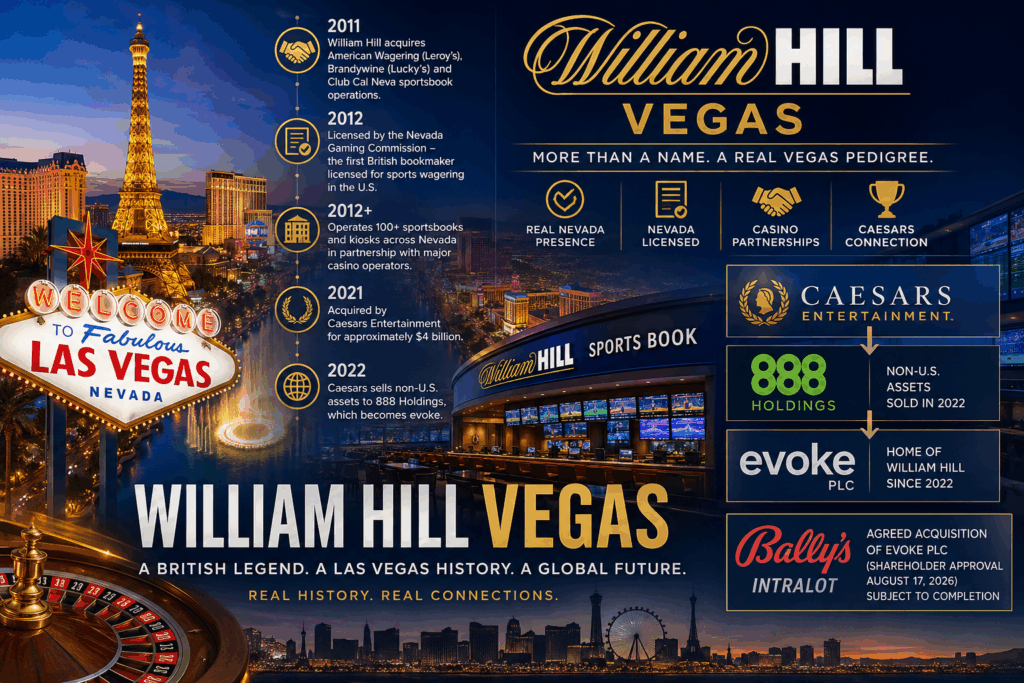
William Hill announced agreements to acquire several established American sports-betting operations, including American Wagering, Brandywine Bookmaking and the sportsbook operations associated with Club Cal Neva.
These were not insignificant businesses.
American Wagering was associated with the Leroy’s sportsbook brand, which had roots going back to 1978 and operated dozens of sportsbooks and betting kiosks for Nevada casino operators.
Brandywine Bookmaking operated the Lucky’s sportsbook business, with locations across Nevada.
The Club Cal Neva sportsbook operation added another established Nevada network.
Rather than attempting to enter Las Vegas with nothing more than a newly created American subsidiary and a marketing campaign, William Hill effectively bought its way into an existing Nevada sports-betting infrastructure.
That gave the British company something particularly valuable: physical presence, operational expertise, existing casino relationships and a route into one of the most closely watched gambling jurisdictions in the world.
The Nevada connection therefore wasn’t theoretical.
It involved actual betting counters, actual casino properties and actual Nevada customers.
William Hill Becomes Licensed in Nevada
The next development is particularly important when assessing William Hill’s claim to genuine Vegas pedigree.
In June 2012, William Hill received approval from the Nevada Gaming Commission.
According to William Hill’s own historical account, the Nevada Gaming Commission unanimously supported the company’s acquisition of the three sportsbook businesses.
William Hill described itself at the time as becoming the first British bookmaker licensed for sports wagering in the United States.
That is a considerable distinction.
Nevada gambling regulation has historically carried enormous international prestige because the state is home to the world’s most famous casino market.
Obtaining the necessary Nevada licensing therefore represented considerably more than receiving permission to put the William Hill logo above a betting counter.
William Hill had crossed from being a British gambling company interested in America into being a genuine participant in Nevada’s regulated gaming industry.
That matters when looking at William Hill Vegas today.
The word “Vegas” does not have to carry the entire marketing story by itself.
There is history behind it.
William Hill Sportsbooks Became Part of the Nevada Casino Landscape
Once the acquisitions and licensing process were completed, William Hill’s presence across Nevada became substantial.
William Hill’s US operation says that it went on to run more than 100 full-service sportsbook and kiosk locations throughout Nevada.
This is one of the strongest reasons why the William Hill Vegas name feels different from a completely artificial Vegas-themed online casino.
William Hill customers could genuinely encounter the brand while gambling in Nevada.
The company wasn’t merely sitting thousands of miles away from Las Vegas telling customers to imagine that they were there.
Its name appeared within the Nevada betting ecosystem itself.
William Hill operated sportsbooks associated with casino properties and entered agreements with casino groups to provide betting services.
The company became part of the machinery that actually makes Nevada sports betting function.
For a British gambling company, that was a significant achievement.
The Affinity Gaming Relationship Strengthened the Casino Connection
One example was William Hill’s relationship with Affinity Gaming.
In June 2012, William Hill announced a long-term agreement to operate sportsbooks at Affinity Gaming properties throughout Nevada.
The arrangement followed William Hill’s acquisitions of Brandywine Bookmaking and the Club Cal Neva operation.
William Hill said it would invest in race and sportsbook facilities across the Affinity portfolio.
That included properties in Las Vegas and elsewhere in Nevada.
This is exactly the kind of historical detail that separates genuine gambling-industry connections from branding exercises.
William Hill wasn’t simply purchasing advertising inside Nevada casinos.
It was providing the sportsbook operation.
That distinction is fundamental.
William Hill and Downtown Las Vegas
William Hill’s Nevada story also extended directly into Downtown Las Vegas.
In 2012, William Hill announced a partnership involving the Plaza Hotel & Casino, one of the best-known properties at the western end of the Fremont Street area.
William Hill’s historical press archive described plans for the Plaza’s race and sportsbook to undergo significant upgrades.
For anyone familiar with Las Vegas, Downtown carries a particular significance.
The Strip may dominate modern international tourism, but Downtown Las Vegas represents an important part of the city’s casino heritage.
A William Hill sportsbook operating within that environment makes the company’s Nevada connection tangible.
It wasn’t Vegas-inspired.
It was in Vegas.
William Hill Had Something Many European Gambling Brands Never Achieved
This point deserves emphasis.
Countless European gambling companies have advertised themselves using American casino imagery.
Far fewer have successfully entered Nevada.
The barriers are considerable.
Nevada requires licensing, regulatory scrutiny, suitable technology, operational infrastructure and relationships with established gaming businesses.
William Hill crossed those barriers.
The company was therefore not simply exporting British bookmaking branding to American customers.
It became a Nevada gaming operator.
That achievement arguably gives the William Hill name an unusual transatlantic character.
It combines traditional British bookmaking heritage with genuine American sportsbook history.
Then Came an Even Bigger Las Vegas Connection: Caesars Entertainment
William Hill’s relationship with the American casino industry eventually became considerably deeper.
In April 2021, Caesars Entertainment completed its acquisition of William Hill PLC for approximately $4 billion.
This is perhaps the single strongest corporate connection between William Hill and Las Vegas.
Caesars is not simply another gambling company.
It is one of the defining corporate names in the history and development of casino entertainment in Las Vegas.
Caesars Palace alone is an internationally recognised symbol of the Strip, while the wider Caesars organisation has operated an enormous portfolio of casino and entertainment properties.
When Caesars completed the William Hill acquisition, it brought together a major American casino operator and one of Britain’s best-known bookmakers.
For a period, therefore, William Hill was literally owned by one of the giants of Las Vegas casino gaming.
That takes the Vegas connection well beyond branding.
Why Caesars Wanted William Hill
The strategic rationale was primarily about sports betting and online gambling in the United States.
Following the liberalisation of sports betting across numerous American states, casino operators recognised that digital sports wagering could become an enormous extension of their existing gaming businesses.
William Hill already possessed sportsbook technology, expertise, customers and US market access.
Caesars possessed casino properties, databases, brands and enormous customer reach.
The combination therefore made considerable strategic sense.
Caesars said that the acquisition brought together two leading sports-betting and iGaming operations.
At completion in 2021, the combined operations offered sports betting across 18 US jurisdictions, with mobile sports betting available in 13 of them.
William Hill had travelled a remarkable distance from its British bookmaker origins.
The company had entered Nevada, established a major sportsbook network and ultimately been acquired by Caesars Entertainment.
Caesars Eventually Kept the American Business and Sold the International Operations
This is where understanding today’s William Hill structure becomes important.
Caesars’ principal strategic interest was the US operation.
The international William Hill business was subsequently sold.
In July 2022, Caesars completed the sale of William Hill’s non-US assets to 888 Holdings plc.
Caesars reported net proceeds of approximately $730 million after debt repayment and other adjustments.
This effectively separated the William Hill story.
The US sportsbook operation remained within Caesars’ sphere, while the international William Hill business, including the familiar UK operation, moved into 888.
That means somebody playing William Hill Vegas in Britain today should not interpret the product as being operated by Caesars Entertainment.
It isn’t.
However, the historical Caesars relationship remains highly relevant when discussing William Hill’s Vegas pedigree.
The company really was owned by Caesars.
Its American operations really were integrated into a major US casino strategy.
Its Nevada history really existed.
The corporate ownership subsequently changed, but the history did not disappear.
888 Holdings Became evoke
The next transformation occurred when 888 Holdings changed its corporate identity.
The group became evoke plc.
Evoke today owns and operates internationally recognised gambling brands including William Hill, 888casino, 888sport, 888poker and Mr Green.
William Hill therefore continues as one of the group’s principal consumer brands.
The corporate name may have changed, but William Hill remains one of the most valuable pieces of gambling heritage within the portfolio.
That heritage now stretches across Britain, Europe and the United States.
William Hill Vegas Within the Modern Portfolio
William Hill Vegas consequently occupies an interesting position.
It takes the William Hill name, with nearly a century of British gambling heritage, and combines it with the Vegas proposition.
If William Hill had never operated in Nevada, that combination could reasonably be regarded as primarily marketing.
But William Hill did operate there.
Its historical US business was built around Nevada sportsbooks.
It held Nevada gaming licences.
It operated at casino properties.
It developed partnerships with Nevada casino operators.
It built a substantial sportsbook network.
It was then acquired by Caesars Entertainment.
That sequence gives William Hill Vegas something many similarly named products cannot claim.
There is an actual historical bridge between the brand and Las Vegas.
And Now Bally’s Enters the Story
The story became even more interesting in 2026.
Bally’s Intralot announced a recommended all-share acquisition of evoke plc.
Evoke shareholders subsequently approved the proposed transaction in August 2026, although completion remains subject to the transaction process and applicable conditions.
This means it is important to describe the position accurately.
William Hill should not simply be described as already owned by Bally’s Intralot while the acquisition process remains incomplete.
What can be said is that Bally’s Intralot has agreed a recommended acquisition of evoke, the owner of William Hill and William Hill Vegas.
That creates another fascinating casino connection.
Why the Bally’s Name Matters
Bally’s is another name carrying substantial American casino heritage.
The Bally’s name has appeared across the US casino industry for decades and has particularly strong historical associations with Las Vegas.
The famous Bally’s Las Vegas property occupied one of the most prominent positions on the Strip before Caesars Entertainment rebranded the resort as Horseshoe Las Vegas.
Modern Bally’s Corporation is a separate corporate story from some of the historical incarnations associated with the Bally name, so those histories should not be casually merged.
Nevertheless, Bally’s Corporation today is unquestionably a significant American casino operator.
Its activities span physical casinos, gaming and entertainment developments.
It has also pursued major casino projects in markets including Chicago and New York.
The involvement of Bally’s Corporation in the wider Bally’s Intralot structure therefore brings another substantial land-based gaming dimension to the group seeking to acquire evoke.
Understanding Bally’s Intralot
The corporate structure deserves careful explanation because it can otherwise become confusing.
Bally’s Intralot is a publicly listed Greek company in which Bally’s Corporation holds a significant controlling investment.
According to a June 2026 filing by Bally’s Corporation with the US Securities and Exchange Commission, Bally’s held approximately 59.44% of Bally’s Intralot’s outstanding shares as of 31 March 2026.
Bally’s Intralot subsequently reached agreement to acquire evoke.
Evoke owns William Hill.
Therefore, assuming completion of the acquisition, the William Hill business would become part of a group with another significant connection to the American casino industry through Bally’s.
That is quite a corporate journey.
William Hill’s Transatlantic Journey
Consider the complete sequence.
William Hill begins as a British bookmaker.
It grows into one of Britain’s dominant betting brands.
It expands online.
It acquires established Nevada sportsbook operators.
It becomes licensed by the Nevada Gaming Commission.
It operates sportsbooks across Nevada.
It develops relationships with casino operators.
It establishes a physical presence within the Las Vegas gambling market.
It is acquired by Caesars Entertainment.
Caesars retains the US operation while selling the international William Hill assets to 888 Holdings.
888 becomes evoke.
Bally’s Intralot then agrees to acquire evoke.
That is not a superficial relationship with casino culture.
It is decades of corporate activity connecting one British bookmaker to some of the biggest names and markets in global gambling.
The Intralot Element Adds Another Layer
Intralot brings yet another dimension to the story.
The business has extensive experience in lottery and gaming technology internationally.
The proposed combination is therefore not simply about putting another casino company’s logo above William Hill.
It potentially brings together a collection of capabilities spanning sportsbooks, online casino, retail betting, lottery technology, gaming systems and established consumer brands.
The acquisition announcement described evoke as one of the world’s leading betting and gaming companies by revenue.
Its brands include William Hill, William Hill Vegas, 888casino, 888sport, 888poker, Winner and Mr Green.
That gives the combined business a considerable consumer-facing gambling portfolio.
William Hill Vegas Is Therefore an Unusually Appropriate Name
This brings us back to the original point.
Casino branding is filled with borrowed imagery.
A casino does not have to operate in Monaco to use Monaco-inspired branding.
It does not need a physical palace to put “Palace” in its name.
It does not need to operate on the Las Vegas Strip to use neon signs, roulette wheels and Vegas imagery.
Marketing creates associations.
That is perfectly normal.
But there is still a difference between association and pedigree.
William Hill has pedigree.
When William Hill places “Vegas” alongside its name, there is a documented historical relationship between William Hill and Nevada gambling.
That does not mean William Hill Vegas is somehow a digital version of a particular Las Vegas casino.
It isn’t.
It means the underlying William Hill brand has genuinely participated in the gambling industry that made Las Vegas famous.
From British Betting Shops to Nevada Sportsbooks
There is also something culturally interesting about the William Hill story.
British and American gambling traditionally developed very differently.
Britain built an enormous high-street bookmaking culture.
America built casino sportsbooks.
The British customer might historically have visited a William Hill shop on their local high street to bet on football or horse racing.
The Nevada customer might walk through a casino to place a wager at a sportsbook.
William Hill ultimately operated in both worlds.
That makes the brand a particularly good example of how global gambling converged during the internet era.
Retail betting, sportsbooks, casino gaming and digital platforms increasingly became parts of the same international industry.
William Hill was involved in that transition at almost every stage.
The Nevada Acquisitions Were the Critical Turning Point
If there is one moment that validates the Vegas association more than any other, it is probably William Hill’s 2011–2012 Nevada expansion.
The company acquired businesses that already understood the local sportsbook market.
American Wagering brought Leroy’s.
Brandywine brought Lucky’s.
Club Cal Neva brought another established sportsbook network.
William Hill then brought these operations under its own identity.
This wasn’t an advertising partnership.
It was operational expansion.
William Hill became responsible for taking bets in Nevada.
That is genuine gambling pedigree.
Nevada Licensing Matters
The licensing dimension should not be underestimated either.
Nevada is not a jurisdiction where a major gambling company simply launches because it has sufficient marketing money.
Gaming regulation is central to the state’s casino industry.
William Hill’s successful licensing therefore represented institutional acceptance of the company as a suitable participant in the Nevada market.
William Hill’s own historical material records that the Nevada Gaming Commission unanimously granted the relevant licences in June 2012.
At the time, William Hill described the approval as breaking new ground for the organisation.
It was.
A British bookmaker had become a Nevada sportsbook operator.
The Caesars Chapter Makes the Connection Even Stronger
If the Nevada acquisitions created the operational connection, Caesars added the corporate connection.
Caesars Entertainment is inseparable from modern Las Vegas.
The company’s resorts and predecessor businesses have played enormous roles in the development of the Strip.
For William Hill to become part of Caesars was therefore symbolically significant as well as commercially important.
A bookmaker that had once looked across the Atlantic towards Nevada was now owned by one of America’s casino giants.
Few British betting brands can point to an equivalent corporate journey.
William Hill Vegas Can Trade on History Rather Than Fantasy
That is ultimately why William Hill Vegas stands out.
The marketing department does not have to invent the entire connection.
The historical record already provides it.
William Hill can evoke Las Vegas because William Hill has been there.
It can talk about sportsbook culture because it operated sportsbooks.
It can associate itself with Nevada gaming because it was licensed in Nevada.
It can point towards major casino relationships because those relationships existed.
It can include Caesars Entertainment in its corporate history because Caesars bought the company.
And now the proposed Bally’s Intralot acquisition potentially introduces another major casino and gaming organisation into the story.
The Important Distinction for Players
None of this means that playing William Hill Vegas online in Britain is equivalent to gambling at a casino in Nevada.
The regulatory environments are different.
The products are different.
The operators and corporate structures are different.
UK customers play within the British regulated online-gambling environment.
Nor should historical corporate relationships be presented as current ones after ownership has changed.
Caesars Entertainment no longer owns the international William Hill business.
That business was sold to 888 Holdings in 2022 and subsequently became part of evoke.
Likewise, the Bally’s Intralot transaction should be described as a proposed or agreed acquisition until it has formally completed.
Those distinctions matter.
But none of them diminish William Hill’s historical relationship with Nevada.
A Rare Case Where “Vegas” Has Substance Behind It
That leaves E-Vegas.com with a relatively simple conclusion.
We see the word Vegas used everywhere in online gambling.
Sometimes it represents little more than a visual theme.
Put a Las Vegas skyline behind a roulette wheel, add some neon lettering and an ordinary online casino suddenly feels connected to the Strip.
William Hill Vegas deserves a little more credit than that.
The underlying William Hill business crossed the Atlantic and entered Nevada for real.
It acquired established sportsbook businesses.
It went through Nevada’s licensing process.
It operated betting locations throughout the state.
It worked inside Nevada casinos.
It established itself as a major sportsbook operator.
It subsequently became part of Caesars Entertainment.
Its international business then passed to 888 and evoke.
Now Bally’s Intralot is seeking to acquire evoke, potentially connecting William Hill with another international gaming group backed by a major American casino operator.
The name William Hill Vegas therefore sits on top of a surprisingly substantial piece of gambling history.
From William Hill to Vegas and Back Again
Perhaps the most interesting aspect of the story is that William Hill never needed Las Vegas to create its identity.
William Hill already had one.
It had been operating since 1934.
It had generations of British customers.
It had thousands of betting-shop employees and one of the most recognisable names in British gambling.
Vegas came later.
William Hill entered Nevada because the company had become large and sophisticated enough to participate in one of the world’s most demanding gambling markets.
That makes the relationship more credible.
William Hill did not create a Vegas-themed casino first and construct a story around it afterwards.
The company accumulated genuine Nevada history and eventually created a casino proposition capable of drawing upon that history.
The E-Vegas.com Verdict
At E-Vegas.com, we spend a great deal of time looking at the relationship between physical Las Vegas and online gambling.
The two worlds constantly borrow from each other.
Online casinos imitate the atmosphere of casino floors.
Live dealers recreate table games through video streams.
Game developers build digital versions of roulette, blackjack and slots designed to evoke destination casinos.
Operators use Las Vegas imagery because players immediately understand what it represents.
Most of the time, that relationship is aspirational.
With William Hill, it is partly historical.
William Hill has earned considerably more right than most online gambling brands to put “Vegas” in the name.
Its heritage is British, but its story genuinely runs through Nevada.
From the acquisition of Leroy’s, Lucky’s and Club Cal Neva sportsbook operations to Nevada licensing, more than 100 betting locations, casino partnerships and eventually the Caesars Entertainment acquisition, William Hill became part of the real American gambling industry.
The subsequent separation of the international business does not erase that history.
Neither does the transformation of 888 Holdings into evoke.
And if the proposed Bally’s Intralot acquisition completes, another major chapter will begin.
For players looking at William Hill Vegas today, therefore, the most interesting thing about the name may be what sits behind it.
There are hundreds of gambling products capable of putting a photograph of the Strip on a homepage.
There are far fewer whose corporate ancestors actually took bets there.
William Hill is one of them.
That makes William Hill Vegas something slightly different in a market overflowing with Las Vegas imagery.
It isn’t merely borrowing the Vegas story.
William Hill has already been part of it.